KNOWLEDGE BASE
Structural Engineer’s Guide Part 2: Using Bend checks
In a previous article, we discussed add loads and their crucial role in preparing joist designs for unknown or shifting load placements, especially when mechanical equipment or other concentrated loads are determined late in the design process.
So, what happens when a load occurs away from a panel point? Per the Steel Joist Institute (SJI), "for nominal concentrated loads, which have been accounted for in the specified uniform design loads, a ‘strut’ to transfer the load to a panel point on the opposite chord shall not be required provided that the sum of the concentrated loads within a chord panel does not exceed 100 lbs. and the attachments are concentric to the chord." That "strut" becomes a requirement for the steel erector to install an unknown number of additional webs across the entire project at off-panel concentrated loads. In practice, this can turn into an expensive procedure, often being excluded upfront and a change order later. A bend check can be used to avoid this issue entirely.
A bend check is different than an add load and the two can be specified without the other. It functions as a verification of the joist chord’s bending strength when loads are applied between panel points, ensuring that the top or bottom chords are designed for the expected local bending. Bend checks allow loads to be safely placed off-panel without requiring last-minute field modifications.
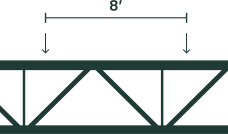
For example, consider an RTU with curbs 8-ft apart. If you know that is wider than the expected panel point spacing (which can be confirmed by contacting your local Vulcraft technical expert), both RTU curbs will never land within a single panel. So any specified bend check would only need to be one of the curb end reactions - not both.
WHY ARE BEND CHECKS IMPORTANT?
They avoid on-site reinforcing: Without a bend check, shifting a load even a foot off a panel point could mean welding additional reinforcements in the field—an expensive and time-consuming fix.
Bend checks are ideal for long-span applications: When loads might be moved slightly after installation, bend checks provide necessary flexibility.
They can help prevent construction delays: Instead of delaying a project while engineers scramble to modify joists, bend checks ensure that small adjustments don’t become major problems.
They also allow some level of precision in calling for the check at the top chord and/or bottom chord. In the case of an RTU, perhaps only the top chord of the joist needs checking. In the case of a basketball backboard hung for an indoor sport facility, perhaps only the bottom chord. And in compound scenarios, perhaps with a joist carrying BOTH an RTU above and backboard below, different bend checks can be specified (example: 500 lbs. Top Chord bend check & 300 lbs. Bottom Chord bend check).
BEST PRACTICES FOR SPECIFYING BEND CHECKS:
- Focus on the Worst-Case Scenario
Engineers don’t need to know exact load placements—just the maximum potential load per location. That said, evaluating worst-case scenarios does not mean combining all loads simultaneously. Worst-case means identifying the single most demanding load case.
- Use Clear and Simple Specifications (but be precise in desired outcome)
Vulcraft always recommends using the SJI’s suggested language:
- "Design for additional bending stresses resulting from a (___) lb. concentrated load located at any location along (top / bottom) chord." This would be interpreted – and likely confirmed on Vulcraft’s approval drawings – to be a Bend Check only.
- "Design joist for a (___) lb. concentrated load at any location along the (top / bottom chord." This would be interpreted as both an Add Load and Bend Check.
- Drafting your own description can easily lead to confusion. Something like "Design for (___) lb. concentrated load along span" opens up a few questions. Is that both an add load and bend check? If a bend check, top or bottom chord?
- Communicate with MEP Teams Early
Even if mechanical engineers don’t have finalized plans, early coordination can help establish realistic requirements.
INNOVATIVE HANGING SOLUTIONS FOR MEP FLEXIBILITY
Bend checks give structural engineers the flexibility to handle unknowns without delays during detailing or costly field modifications. They ensure joist and deck systems can support real-world conditions—even when load placements shift after installation. By implementing this tool effectively, engineers can design with confidence, prevent last-minute surprises, and keep projects on schedule.
At Vulcraft and Verco, we strive to be Powerful Partners in your projects. If you’re unsure how to specify or interpret loads, reach out to us. We’re here to help streamline the design process and ensure a smooth, successful project.
About the author
Alex Brown is a Product Champion with Vulcraft/Verco's Innovation Services Group, where he researches, develops, and implements exciting new steel joist & deck solutions across North America. He has twelve years experience with Vulcraft, split between his current role and as Sales Engineer for Vulcraft's Chicago territory. Alex is a licensed Professional Engineer (Indiana) and a certified Construction Document Technologist through the Construction Specification Institute.