

AXIAL LOADS
If you’re building in an area that experiences high wind or seismic forces, Vulcraft’s custom-engineered steel joists can help. Incorporating joists in your lateral-resisting system is straightforward and cost-effective.
Our team of experts can help you navigate your structure’s challenges and manage complex load paths, even in the most demanding conditions.
The specifying professional should note the axial load on the drawings, whether it is due to wind or seismic forces, and whether ASD or LRFD design loads are to be used.
DESIGN SPECIFICATIONS
MAX ALLOWABLE JOIST SEAT AND JOIST CHORD
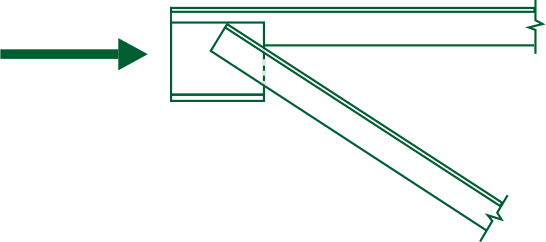
DEEPER SEATS WILL HAVE DECREASED CAPACITY.
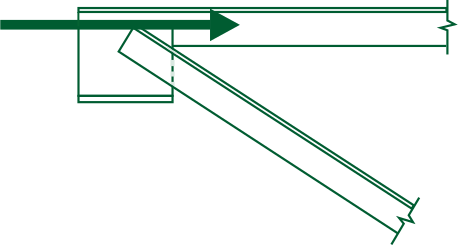
OPEN WEB STEEL JOISTS
Joists are excellent for resisting the various wind or seismic lateral loads that a building may experience. These are often translated into axial loads, which are in the direction of the joist length. While these loads may accumulate or dissipate through the deck diaphragm, they often need to be transferred from the end of one joist into the adjacent one.
The seat of the joist has some capacity to resist axial loads. The load path would be through the joist-bearing seat into the shared girder member and into the next joist’s bearing seat. But this is not an ideal condition for larger loads.
When the axial loads exceed 26 kips / 200 kips, then additional transfer material is needed. In these types of scenarios, we recommend a tie plate (Detail A), angle (Detail B), or knife plate (Detail C).


